agent-orchestrator
Agent orchestrator for parallel coding agents — plans tasks, fixes CI, handles merge conflicts, manages PRs
Agent Orchestrator manages fleets of AI coding agents, each in its own git worktree, to autonomously handle development tasks. It spawns agents for issues, routes CI failures and review comments back to them, and allows human supervision from a central dashboard. Supports agents like Claude Code, Codex, and Aider, with runtime options like tmux or Docker, installed via npm.
- Spawns agents in isolated git worktrees for each task
- Automatically routes CI failures and review comments to agents
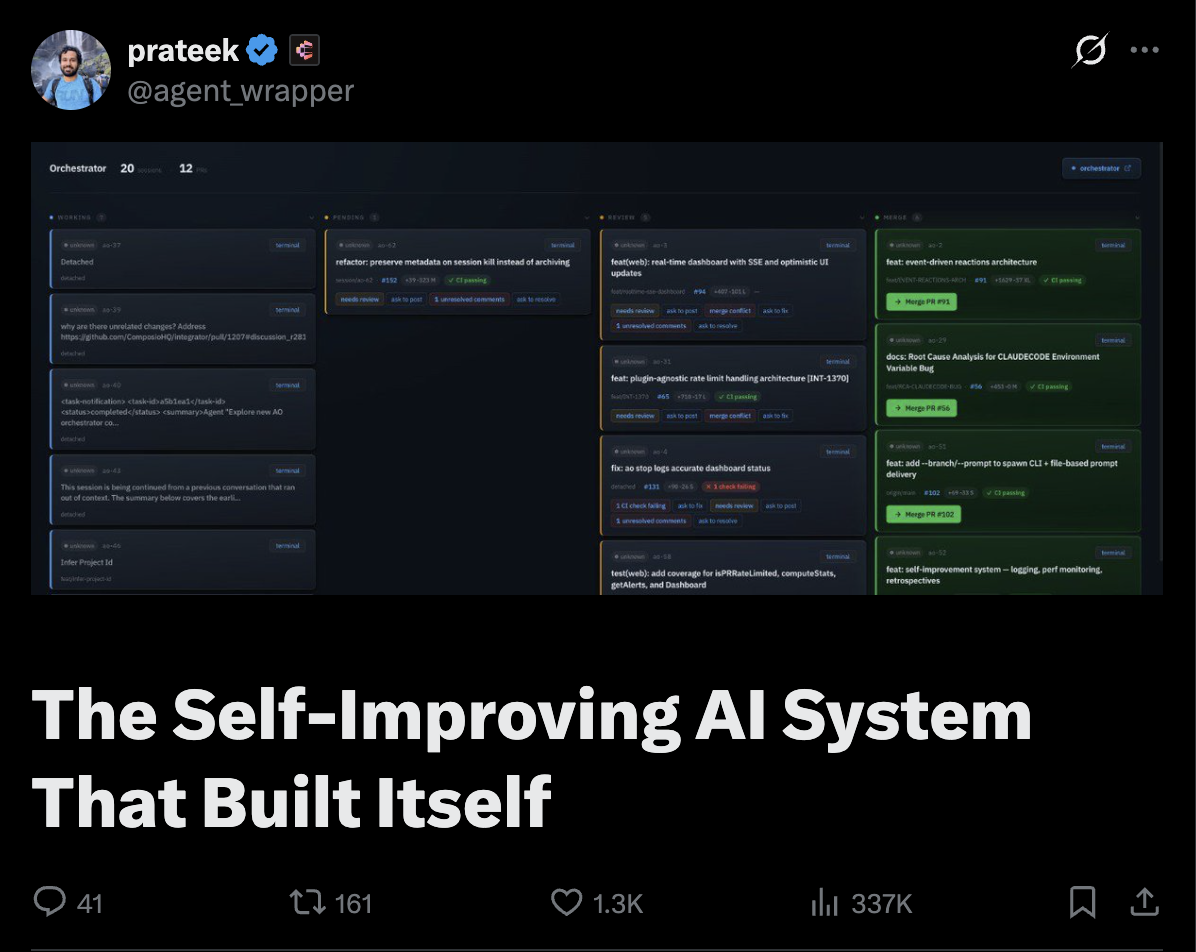
- Dashboard for supervising agent activity and reviewing PRs
- Agent-agnostic plugin architecture for various LLMs and runtimes
- Keeps macOS awake for remote dashboard access via caffeinate


README
View on GitHub ↗Agent Orchestrator — The Orchestration Layer for Parallel AI Agents
Spawn parallel AI coding agents, each in its own git worktree. Agents autonomously fix CI failures, address review comments, and open PRs — you supervise from one dashboard.





Agent Orchestrator manages fleets of AI coding agents working in parallel on your codebase. Each agent gets its own git worktree, its own branch, and its own PR. When CI fails, the agent fixes it. When reviewers leave comments, the agent addresses them. You only get pulled in when human judgment is needed.
Agent-agnostic (Claude Code, Codex, Aider) · Runtime-agnostic (tmux, Docker) · Tracker-agnostic (GitHub, Linear)
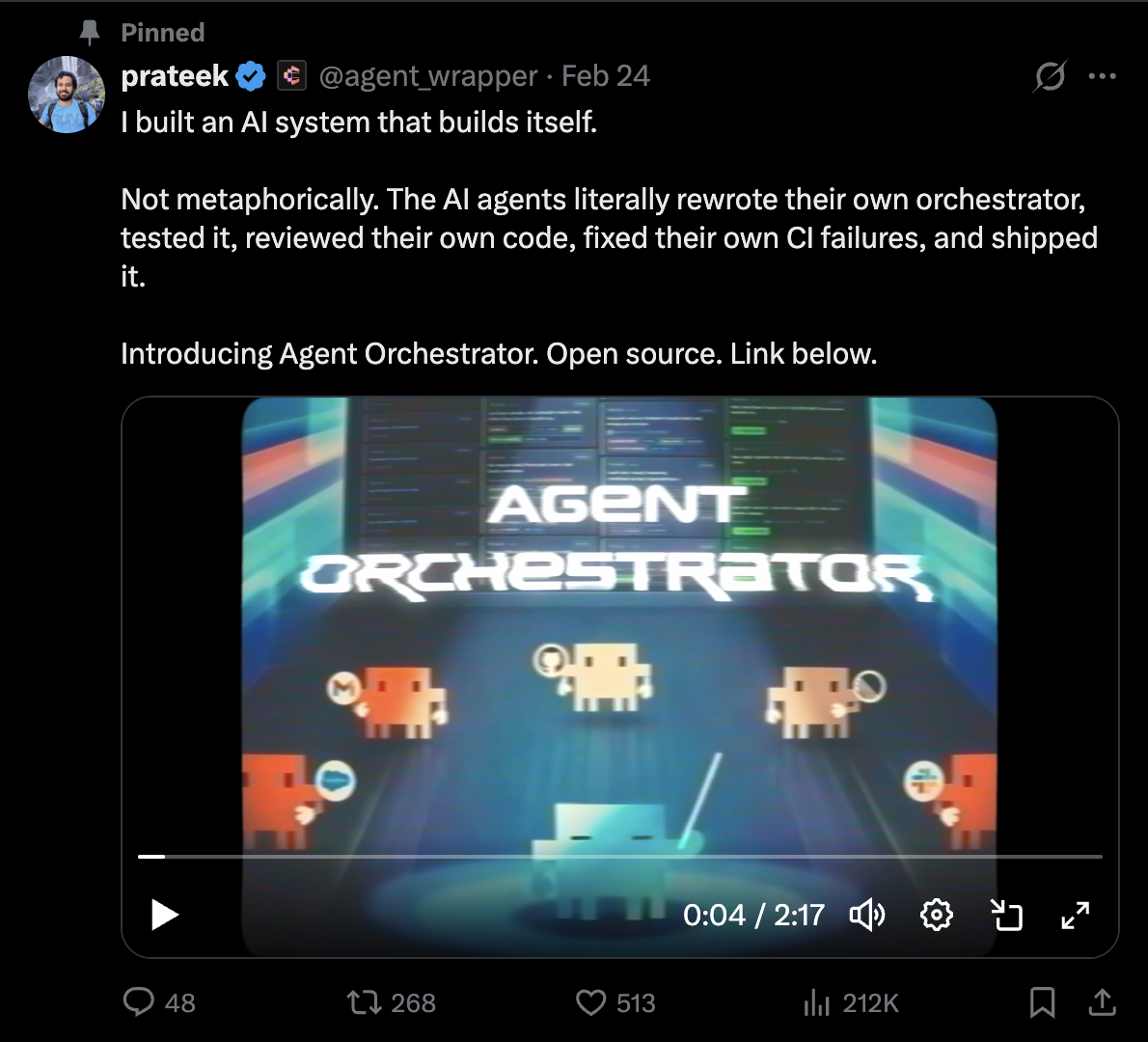
See it in action


Quick Start
Prerequisites: Node.js 20+, Git 2.25+, tmux,
ghCLI. Install tmux viabrew install tmux(macOS) orsudo apt install tmux(Linux).
Install
npm install -g @aoagents/ao
Permission denied? Install from source?
If npm install -g fails with EACCES, prefix with sudo or fix your npm permissions.
To install from source (for contributors):
git clone https://github.com/ComposioHQ/agent-orchestrator.git
cd agent-orchestrator && bash scripts/setup.sh
Start
Point it at any repo — it clones, configures, and launches the dashboard in one command:
ao start https://github.com/your-org/your-repo
Or from inside an existing local repo:
cd ~/your-project && ao start
That's it. The dashboard opens at http://localhost:3000 and the orchestrator agent starts managing your project.
Add more projects
ao start ~/path/to/another-repo
How It Works
- You start —
ao startlaunches the dashboard and an orchestrator agent - Orchestrator spawns workers — each issue gets its own agent in an isolated git worktree
- Agents work autonomously — they read code, write tests, create PRs
- Reactions handle feedback — CI failures and review comments are automatically routed back to the agent
- You review and merge — you only get pulled in when human judgment is needed
The orchestrator agent uses the AO CLI internally to manage sessions. You don't need to learn or use the CLI — the dashboard and orchestrator handle everything.
Configuration
ao start auto-generates agent-orchestrator.yaml with sensible defaults. You can edit it afterwards to customize behavior:
# agent-orchestrator.yaml
# Runtime data is auto-derived under ~/.agent-orchestrator/{hash}-{projectId}/
port: 3000

defaults:
  runtime: tmux
  agent: claude-code
  workspace: worktree
  notifiers: [desktop]

projects:
  my-app:
    repo: owner/my-app
    path: ~/my-app
    defaultBranch: main
    sessionPrefix: app

reactions:
  ci-failed:
    auto: true
    action: send-to-agent
    retries: 2
  changes-requested:
    auto: true
    action: send-to-agent
    escalateAfter: 30m
  approved-and-green:
    auto: false # flip to true for auto-merge
    action: notify
CI fails → agent gets the logs and fixes it. Reviewer requests changes → agent addresses them. PR approved with green CI → you get a notification to merge.
See agent-orchestrator.yaml.example for the full reference, or run ao config-help for the complete schema.
Remote Access
AO keeps your Mac awake while running, so you can access the dashboard remotely (e.g., via Tailscale from your phone) without the machine going to sleep.
How it works: On macOS, AO automatically holds an idle-sleep prevention assertion using caffeinate. When AO exits, the assertion is released.
# agent-orchestrator.yaml
power:
  preventIdleSleep: true  # Default on macOS, no-op on Linux
Set to false if you want to allow idle sleep while AO runs.
Lid-close limitation: macOS enforces lid-close sleep at the hardware level — no userspace assertion can override it. If you need remote access while traveling with the lid closed, use clamshell mode (external power + display + input device).
Plugin Architecture
Seven plugin slots. Lifecycle stays in core.
| Slot | Default | Alternatives |
|---|---|---|
| Runtime | tmux | process |
| Agent | claude-code | codex, aider, cursor, opencode |
| Workspace | worktree | clone |
| Tracker | github | linear, gitlab |
| SCM | github | gitlab |
| Notifier | desktop | slack, discord, composio, webhook, openclaw |
| Terminal | iterm2 | web |
All interfaces defined in packages/core/src/types.ts. A plugin implements one interface and exports a PluginModule. That's it.
Why Agent Orchestrator?
Running one AI agent in a terminal is easy. Running 30 across different issues, branches, and PRs is a coordination problem.
Without orchestration, you manually: create branches, start agents, check if they're stuck, read CI failures, forward review comments, track which PRs are ready to merge, clean up when done.
With Agent Orchestrator, you: ao start and walk away. The system handles isolation, feedback routing, and status tracking. You review PRs and make decisions — the rest is automated.
Documentation
| Doc | What it covers |
|---|---|
| Setup Guide | Detailed installation, configuration, and troubleshooting |
| CLI Reference | All ao commands (mostly used by the orchestrator agent) |
| Examples | Config templates (GitHub, Linear, multi-project, auto-merge) |
| Development Guide | Architecture, conventions, plugin pattern |
| Contributing | How to contribute, build plugins, PR process |
Development
pnpm install && pnpm build    # Install and build all packages
pnpm test                      # Run tests (3,288 test cases)
pnpm dev                       # Start web dashboard dev server
See docs/DEVELOPMENT.md for code conventions and architecture details.
Contributing
Contributions welcome. The plugin system makes it straightforward to add support for new agents, runtimes, trackers, and notification channels. Every plugin is an implementation of a TypeScript interface — see CONTRIBUTING.md and the Development Guide for the pattern.
License
MIT
Similar orchestration
paperclip
AI agent orchestration server for autonomous companies — manages teams of bots, goals, budgets, and governance


MiroFish
Swarm intelligence engine for future prediction — simulates multi-agent interactions to deduce outcomes


crewAI
Multi-agent orchestration framework for collaborative AI agents, independent of LangChain


langgraph
Agent orchestration framework for stateful LLM applications — builds resilient, long-running agents with durable execution


