DeepTutor
Agent-native learning platform for personalized tutoring, multi-agent problem solving, and knowledge management
DeepTutor is an agent-native learning platform for personalized tutoring, multi-agent problem solving, and comprehensive knowledge management. It provides a unified chat workspace with autonomous TutorBots, an AI Co-Writer, and a Knowledge Hub for RAG. The system builds a persistent learning profile and supports various LLM providers via web or CLI interfaces.
- Unified chat workspace with five interactive modes
- Autonomous TutorBots with persistent memory and skills
- AI Co-Writer for collaborative Markdown content creation
- Knowledge Hub for RAG-ready PDFs and Markdown files
- Agent-native CLI for full system management


README
View on GitHub ↗
DeepTutor: Agent-Native Personalized Tutoring








Features · Get Started · Explore · TutorBot · CLI · Community
🇨🇳 中文 · 🇯🇵 日本語 · 🇪🇸 Español · 🇫🇷 Français · 🇸🇦 العربية · 🇷🇺 Русский · 🇮🇳 हिन्दी · 🇵🇹 Português · 🇹🇭 ภาษาไทย
📦 Releases
[2026.4.18] v1.1.2 — Schema-driven Channels tab with secret masking, RAG collapsed to single pipeline, RAG/KB consistency hardening, externalized chat prompts, and Thai README.
[2026.4.17] v1.1.1 — Universal "Answer now" across all capabilities, Co-Writer scroll sync, Save-to-Notebook message selection, unified settings panel, streaming Stop button, and TutorBot atomic config writes.
[2026.4.15] v1.1.0 — LaTeX block math parsing overhaul, LLM diagnostic probe via agents.yaml, extra headers forwarding fix, SaveToNotebook UUID fix, and Docker + local LLM guidance.
[2026.4.14] v1.1.0-beta — URL-based bookmarkable sessions, Snow theme, WebSocket heartbeat & auto-reconnect, ChatComposer performance fix, embedding provider registry overhaul, and Serper search provider.
[2026.4.13] v1.0.3 — Question Notebook with bookmarks & categories, Mermaid in Visualize, embedding mismatch detection, Qwen/vLLM compatibility, LM Studio & llama.cpp support, and Glass theme.
[2026.4.11] v1.0.2 — Search consolidation with SearXNG fallback, provider switch fix, and frontend resource leak fixes.
[2026.4.10] v1.0.1 — Visualize capability (Chart.js/SVG), quiz duplicate prevention, and o4-mini model support.
[2026.4.10] v1.0.0-beta.4 — Embedding progress tracking with rate-limit retry, cross-platform dependency fixes, and MIME validation fix.
[2026.4.8] v1.0.0-beta.3 — Native OpenAI/Anthropic SDK (drop litellm), Windows Math Animator support, robust JSON parsing, and full Chinese i18n.
[2026.4.7] v1.0.0-beta.2 — Hot settings reload, MinerU nested output, WebSocket fix, and Python 3.11+ minimum.
[2026.4.4] v1.0.0-beta.1 — Agent-native architecture rewrite (~200k lines): Tools + Capabilities plugin model, CLI & SDK, TutorBot, Co-Writer, Guided Learning, and persistent memory.
Past releases
[2026.1.23] v0.6.0 — Session persistence, incremental document upload, flexible RAG pipeline import, and full Chinese localization.
[2026.1.18] v0.5.2 — Docling support for RAG-Anything, logging system optimization, and bug fixes.
[2026.1.15] v0.5.0 — Unified service configuration, RAG pipeline selection per knowledge base, question generation overhaul, and sidebar customization.
[2026.1.9] v0.4.0 — Multi-provider LLM & embedding support, new home page, RAG module decoupling, and environment variable refactor.
[2026.1.5] v0.3.0 — Unified PromptManager architecture, GitHub Actions CI/CD, and pre-built Docker images on GHCR.
[2026.1.2] v0.2.0 — Docker deployment, Next.js 16 & React 19 upgrade, WebSocket security hardening, and critical vulnerability fixes.
📰 News
[2026.4.4] Long time no see! ✨ DeepTutor v1.0.0 is finally here — an agent-native evolution featuring a ground-up architecture rewrite, TutorBot, and flexible mode switching under the Apache-2.0 license. A new chapter begins, and our story continues!
[2026.2.6] 🚀 We've reached 10k stars in just 39 days! A huge thank you to our incredible community for the support!
[2026.1.1] Happy New Year! Join our Discord, WeChat, or Discussions — let's shape the future of DeepTutor together!
[2025.12.29] DeepTutor is officially released!
✨ Key Features
- Unified Chat Workspace — Five modes, one thread. Chat, Deep Solve, Quiz Generation, Deep Research, and Math Animator share the same context — start a conversation, escalate to multi-agent problem solving, generate quizzes, then deep-dive into research, all without losing a single message.
- Personal TutorBots — Not chatbots — autonomous tutors. Each TutorBot lives in its own workspace with its own memory, personality, and skill set. They set reminders, learn new abilities, and evolve as you grow. Powered by nanobot.
- AI Co-Writer — A Markdown editor where AI is a first-class collaborator. Select text, rewrite, expand, or summarize — drawing from your knowledge base and the web. Every piece feeds back into your learning ecosystem.
- Guided Learning — Turn your materials into structured, visual learning journeys. DeepTutor designs multi-step plans, generates interactive pages for each knowledge point, and lets you discuss alongside each step.
- Knowledge Hub — Upload PDFs, Markdown, and text files to build RAG-ready knowledge bases. Organize insights across sessions in color-coded notebooks. Your documents don't just sit there — they actively power every conversation.
- Persistent Memory — DeepTutor builds a living profile of you: what you've studied, how you learn, and where you're heading. Shared across all features and TutorBots, it gets sharper with every interaction.
- Agent-Native CLI — Every capability, knowledge base, session, and TutorBot is one command away. Rich terminal output for humans, structured JSON for AI agents and pipelines. Hand DeepTutor a
SKILL.mdand your agents can operate it autonomously.
🚀 Get Started
Prerequisites
Before you begin, make sure the following are installed on your system:
| Requirement | Version | Check | Notes |
|---|---|---|---|
| Git | Any | git --version |
For cloning the repository |
| Python | 3.11+ | python --version |
Backend runtime |
| Node.js | 18+ | node --version |
Frontend build (not needed for CLI-only or Docker) |
| npm | 9+ | npm --version |
Bundled with Node.js |
You'll also need an API key from at least one LLM provider (e.g. OpenAI, DeepSeek, Anthropic). The Setup Tour will walk you through entering it.
Option A — Setup Tour (Recommended)
A single interactive script that walks you through everything: dependency installation, environment configuration, live connection testing, and launch. No manual .env editing needed.
git clone https://github.com/HKUDS/DeepTutor.git
cd DeepTutor

# Create a Python virtual environment (pick one):
conda create -n deeptutor python=3.11 && conda activate deeptutor   # if you use Anaconda/Miniconda
python -m venv .venv && source .venv/bin/activate                    # otherwise (macOS/Linux)
python -m venv .venv && .venv\Scripts\activate                       # otherwise (Windows)

# Launch the guided tour
python scripts/start_tour.py
The tour asks how you'd like to use DeepTutor:
- Web mode (recommended) — Installs all dependencies (pip + npm), spins up a temporary server, and opens the Settings page in your browser. A four-step guided tour walks you through LLM, Embedding, and Search provider setup with live connection testing. Once complete, DeepTutor restarts automatically with your configuration.
- CLI mode — A fully interactive terminal flow: choose a dependency profile, install dependencies, configure providers, verify connections, and apply — all without leaving the shell.
Either way, you end up with a running DeepTutor at http://localhost:3782.
Daily launch — The tour is only needed once. From now on, start DeepTutor with:
python scripts/start_web.pyThis boots both the backend and frontend in one command and opens the browser automatically. Re-run
start_tour.pyonly if you need to reconfigure providers or reinstall dependencies.
Option B — Manual Local Install
If you prefer full control, install and configure everything yourself.
1. Install dependencies
git clone https://github.com/HKUDS/DeepTutor.git
cd DeepTutor

# Create & activate a Python virtual environment (same as Option A)
conda create -n deeptutor python=3.11 && conda activate deeptutor

# Install DeepTutor with backend + web server dependencies
pip install -e ".[server]"

# Install frontend dependencies (requires Node.js 18+)
cd web && npm install && cd ..
2. Configure environment
cp .env.example .env
Edit .env and fill in at least the required fields:
# LLM (Required)
LLM_BINDING=openai
LLM_MODEL=gpt-4o-mini
LLM_API_KEY=sk-xxx
LLM_HOST=https://api.openai.com/v1

# Embedding (Required for Knowledge Base)
EMBEDDING_BINDING=openai
EMBEDDING_MODEL=text-embedding-3-large
EMBEDDING_API_KEY=sk-xxx
EMBEDDING_HOST=https://api.openai.com/v1
EMBEDDING_DIMENSION=3072
Supported LLM Providers
| Provider | Binding | Default Base URL |
|---|---|---|
| AiHubMix | aihubmix |
https://aihubmix.com/v1 |
| Anthropic | anthropic |
https://api.anthropic.com/v1 |
| Azure OpenAI | azure_openai |
— |
| BytePlus | byteplus |
https://ark.ap-southeast.bytepluses.com/api/v3 |
| BytePlus Coding Plan | byteplus_coding_plan |
https://ark.ap-southeast.bytepluses.com/api/coding/v3 |
| Custom (OpenAI-compat) | custom |
— |
| DashScope (Qwen) | dashscope |
https://dashscope.aliyuncs.com/compatible-mode/v1 |
| DeepSeek | deepseek |
https://api.deepseek.com |
| Gemini | gemini |
https://generativelanguage.googleapis.com/v1beta/openai/ |
| GitHub Copilot | github_copilot |
https://api.githubcopilot.com |
| Groq | groq |
https://api.groq.com/openai/v1 |
| llama.cpp | llama_cpp |
http://localhost:8080/v1 |
| LM Studio | lm_studio |
http://localhost:1234/v1 |
| MiniMax | minimax |
https://api.minimax.io/v1 |
| Mistral | mistral |
https://api.mistral.ai/v1 |
| Moonshot (Kimi) | moonshot |
https://api.moonshot.ai/v1 |
| Ollama | ollama |
http://localhost:11434/v1 |
| OpenAI | openai |
https://api.openai.com/v1 |
| OpenAI Codex | openai_codex |
https://chatgpt.com/backend-api |
| OpenRouter | openrouter |
https://openrouter.ai/api/v1 |
| OpenVINO Model Server | ovms |
http://localhost:8000/v3 |
| Qianfan (Ernie) | qianfan |
https://qianfan.baidubce.com/v2 |
| SiliconFlow | siliconflow |
https://api.siliconflow.cn/v1 |
| Step Fun | stepfun |
https://api.stepfun.com/v1 |
| vLLM | vllm |
http://localhost:8000/v1 |
| VolcEngine | volcengine |
https://ark.cn-beijing.volces.com/api/v3 |
| VolcEngine Coding Plan | volcengine_coding_plan |
https://ark.cn-beijing.volces.com/api/coding/v3 |
| Xiaomi MIMO | xiaomi_mimo |
https://api.xiaomimimo.com/v1 |
| Zhipu AI (GLM) | zhipu |
https://open.bigmodel.cn/api/paas/v4 |
Supported Embedding Providers
| Provider | Binding | Model Example | Default Dim |
|---|---|---|---|
| OpenAI | openai |
text-embedding-3-large |
3072 |
| Azure OpenAI | azure_openai |
deployment name | — |
| Cohere | cohere |
embed-v4.0 |
1024 |
| Jina | jina |
jina-embeddings-v3 |
1024 |
| Ollama | ollama |
nomic-embed-text |
768 |
| vLLM / LM Studio | vllm |
Any embedding model | — |
| Any OpenAI-compatible | custom |
— | — |
OpenAI-compatible providers (DashScope, SiliconFlow, etc.) work via the custom or openai binding.
Supported Web Search Providers
| Provider | Env Key | Notes |
|---|---|---|
| Brave | BRAVE_API_KEY |
Recommended, free tier available |
| Tavily | TAVILY_API_KEY |
|
| Jina | JINA_API_KEY |
|
| SearXNG | — | Self-hosted, no API key needed |
| DuckDuckGo | — | No API key needed |
| Perplexity | PERPLEXITY_API_KEY |
Requires API key |
3. Start services
The quickest way to launch everything:
python scripts/start_web.py
This starts both the backend and frontend and opens the browser automatically.
Alternatively, start each service manually in separate terminals:
# Backend (FastAPI)
python -m deeptutor.api.run_server

# Frontend (Next.js) — in a separate terminal
cd web && npm run dev -- -p 3782
| Service | Default Port |
|---|---|
| Backend | 8001 |
| Frontend | 3782 |
Open http://localhost:3782 and you're ready to go.
Option C — Docker Deployment
Docker wraps the backend and frontend into a single container — no local Python or Node.js required. You only need Docker Desktop (or Docker Engine + Compose on Linux).
1. Configure environment variables (required for both options below)
git clone https://github.com/HKUDS/DeepTutor.git
cd DeepTutor
cp .env.example .env
Edit .env and fill in at least the required fields (same as Option B above).
2a. Pull official image (recommended)
Official images are published to GitHub Container Registry on every release, built for linux/amd64 and linux/arm64.
docker compose -f docker-compose.ghcr.yml up -d
To pin a specific version, edit the image tag in docker-compose.ghcr.yml:
image: ghcr.io/hkuds/deeptutor:1.0.0 # or :latest
2b. Build from source
docker compose up -d
This builds the image locally from Dockerfile and starts the container.
3. Verify & manage
Open http://localhost:3782 once the container is healthy.
docker compose logs -f   # tail logs
docker compose down       # stop and remove container
Cloud / remote server deployment
When deploying to a remote server, the browser needs to know the public URL of the backend API. Add one more variable to your .env:
# Set to the public URL where the backend is reachable
NEXT_PUBLIC_API_BASE_EXTERNAL=https://your-server.com:8001
The frontend startup script applies this value at runtime — no rebuild needed.
Development mode (hot-reload)
Layer the dev override to mount source code and enable hot-reload for both services:
docker compose -f docker-compose.yml -f docker-compose.dev.yml up
Changes to deeptutor/, deeptutor_cli/, scripts/, and web/ are reflected immediately.
Custom ports
Override the default ports in .env:
BACKEND_PORT=9001
FRONTEND_PORT=4000
Then restart:
docker compose up -d # or docker compose -f docker-compose.ghcr.yml up -d
Data persistence
User data and knowledge bases are persisted via Docker volumes mapped to local directories:
| Container path | Host path | Content |
|---|---|---|
/app/data/user |
./data/user |
Settings, memory, workspace, sessions, logs |
/app/data/knowledge_bases |
./data/knowledge_bases |
Uploaded documents & vector indices |
These directories survive docker compose down and are reused on the next docker compose up.
Environment variables reference
| Variable | Required | Description |
|---|---|---|
LLM_BINDING |
Yes | LLM provider (openai, anthropic, etc.) |
LLM_MODEL |
Yes | Model name (e.g. gpt-4o) |
LLM_API_KEY |
Yes | Your LLM API key |
LLM_HOST |
Yes | API endpoint URL |
EMBEDDING_BINDING |
Yes | Embedding provider |
EMBEDDING_MODEL |
Yes | Embedding model name |
EMBEDDING_API_KEY |
Yes | Embedding API key |
EMBEDDING_HOST |
Yes | Embedding endpoint |
EMBEDDING_DIMENSION |
Yes | Vector dimension |
SEARCH_PROVIDER |
No | Search provider (tavily, jina, serper, perplexity, etc.) |
SEARCH_API_KEY |
No | Search API key |
BACKEND_PORT |
No | Backend port (default 8001) |
FRONTEND_PORT |
No | Frontend port (default 3782) |
NEXT_PUBLIC_API_BASE_EXTERNAL |
No | Public backend URL for cloud deployment |
DISABLE_SSL_VERIFY |
No | Disable SSL verification (default false) |
Option D — CLI Only
If you just want the CLI without the web frontend:
pip install -e ".[cli]"
You still need to configure your LLM provider. The quickest way:
cp .env.example .env # then edit .env to fill in your API keys
Once configured, you're ready to go:
deeptutor chat                                   # Interactive REPL
deeptutor run chat "Explain Fourier transform"   # One-shot capability
deeptutor run deep_solve "Solve x^2 = 4"         # Multi-agent problem solving
deeptutor kb create my-kb --doc textbook.pdf     # Build a knowledge base
See DeepTutor CLI for the full feature guide and command reference.
What's Next?
Once DeepTutor is running, here are some things to try first:
- Upload a document — Go to the Knowledge page and create a knowledge base from a PDF or Markdown file.
- Start a conversation — Open Chat, select your knowledge base, and ask a question.
- Try Deep Solve — Switch to Deep Solve mode for a step-by-step, multi-agent solution with citations.
- Create a TutorBot — Build a persistent AI tutor with its own personality and memory.
Explore all features in the Explore DeepTutor section below.
📖 Explore DeepTutor
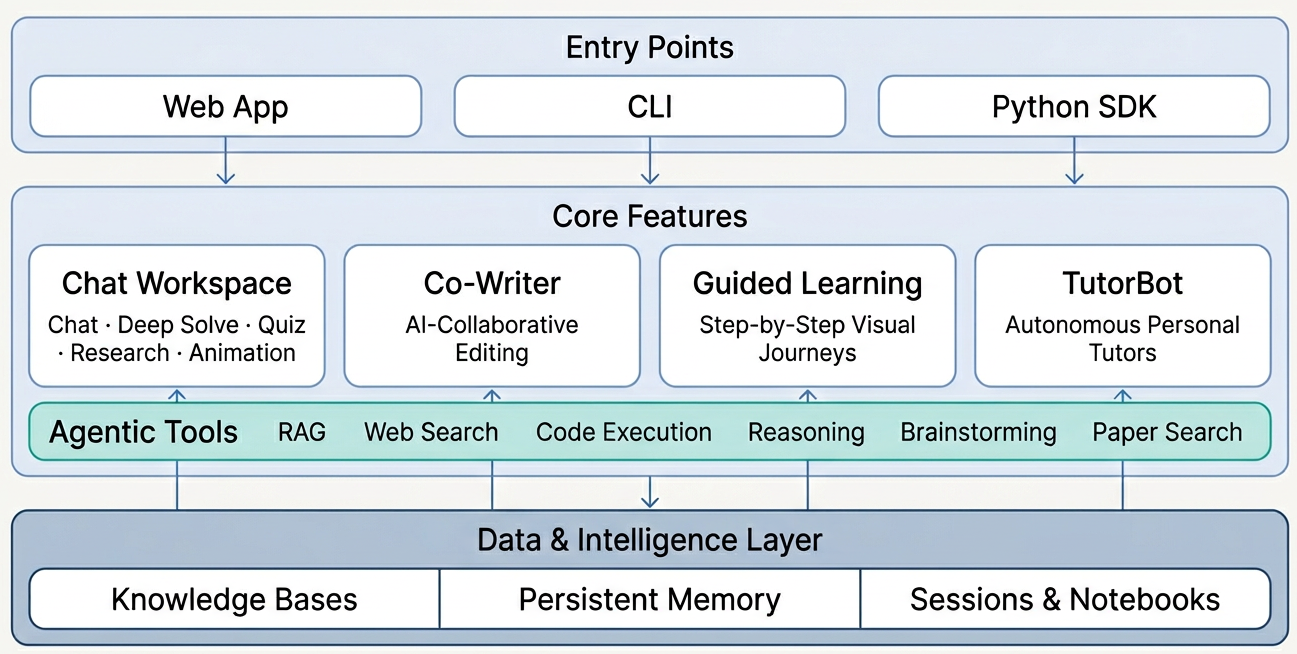
💬 Chat — Unified Intelligent Workspace
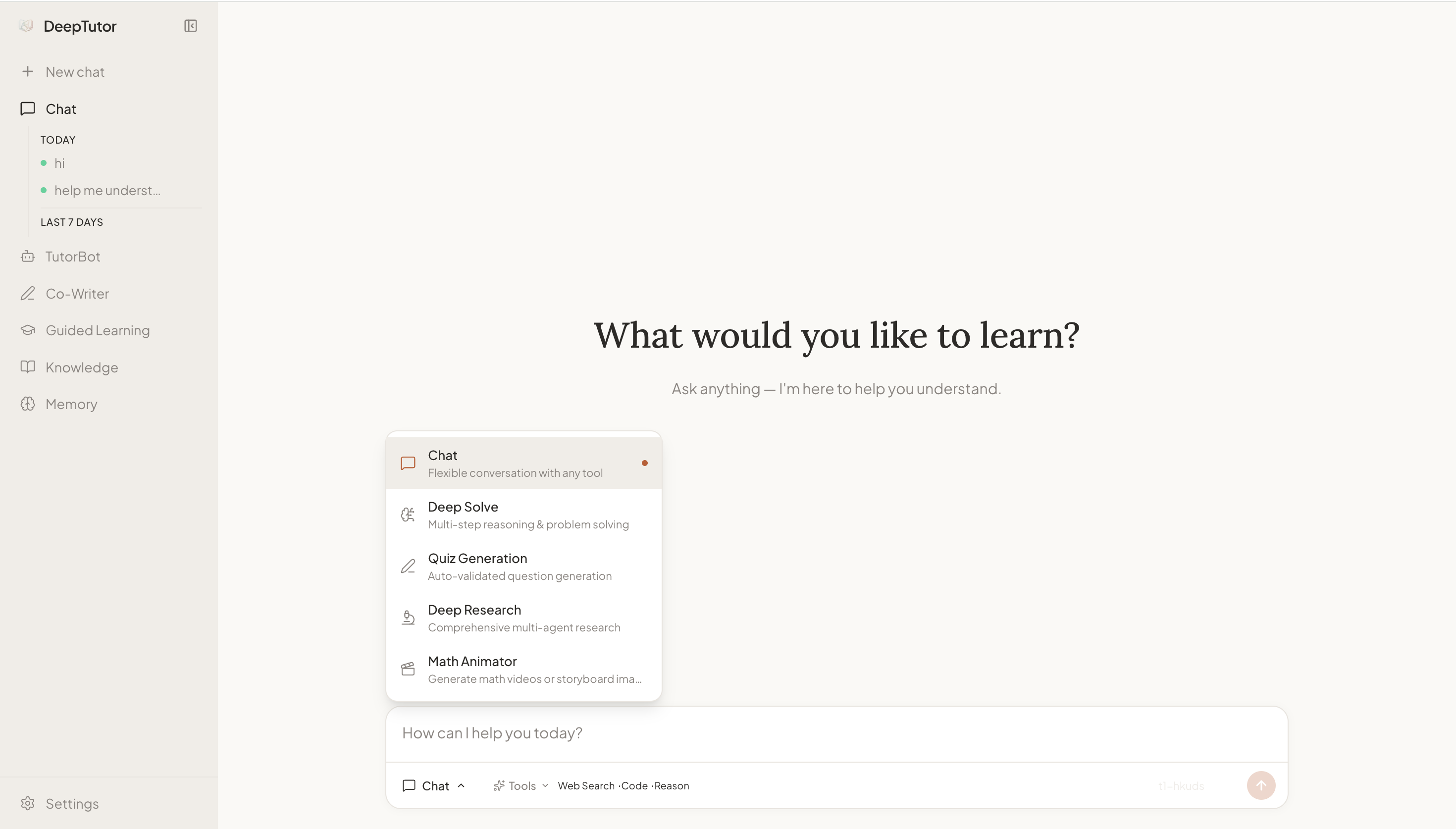
Five distinct modes coexist in a single workspace, bound by a unified context management system. Conversation history, knowledge bases, and references persist across modes — switch between them freely within the same topic, whenever the moment calls for it.
| Mode | What It Does |
|---|---|
| Chat | Fluid, tool-augmented conversation. Choose from RAG retrieval, web search, code execution, deep reasoning, brainstorming, and paper search — mix and match as needed. |
| Deep Solve | Multi-agent problem solving: plan, investigate, solve, and verify — with precise source citations at every step. |
| Quiz Generation | Generate assessments grounded in your knowledge base, with built-in validation. |
| Deep Research | Decompose a topic into subtopics, dispatch parallel research agents across RAG, web, and academic papers, and produce a fully cited report. |
| Math Animator | Turn mathematical concepts into visual animations and storyboards powered by Manim. |
Tools are decoupled from workflows — in every mode, you decide which tools to enable, how many to use, or whether to use any at all. The workflow orchestrates the reasoning; the tools are yours to compose.
Start with a quick chat question, escalate to Deep Solve when it gets hard, generate quiz questions to test yourself, then launch a Deep Research to go deeper — all in one continuous thread.
✍️ Co-Writer — AI Inside Your Editor
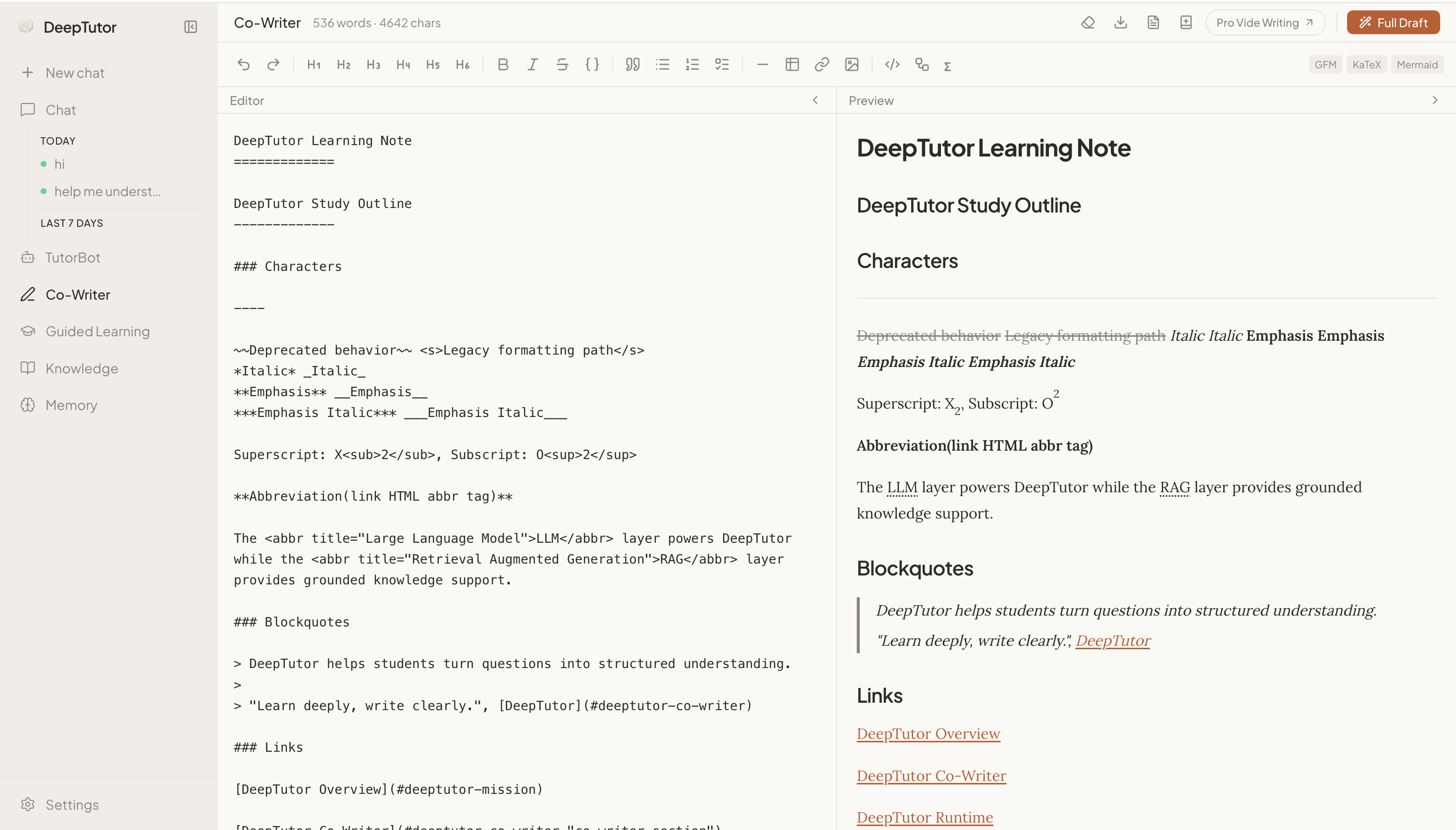
Co-Writer brings the intelligence of Chat directly into a writing surface. It is a full-featured Markdown editor where AI is a first-class collaborator — not a sidebar, not an afterthought.
Select any text and choose Rewrite, Expand, or Shorten — optionally drawing context from your knowledge base or the web. The editing flow is non-destructive with full undo/redo, and every piece you write can be saved straight to your notebooks, feeding back into your learning ecosystem.
🎓 Guided Learning — Visual, Step-by-Step Mastery
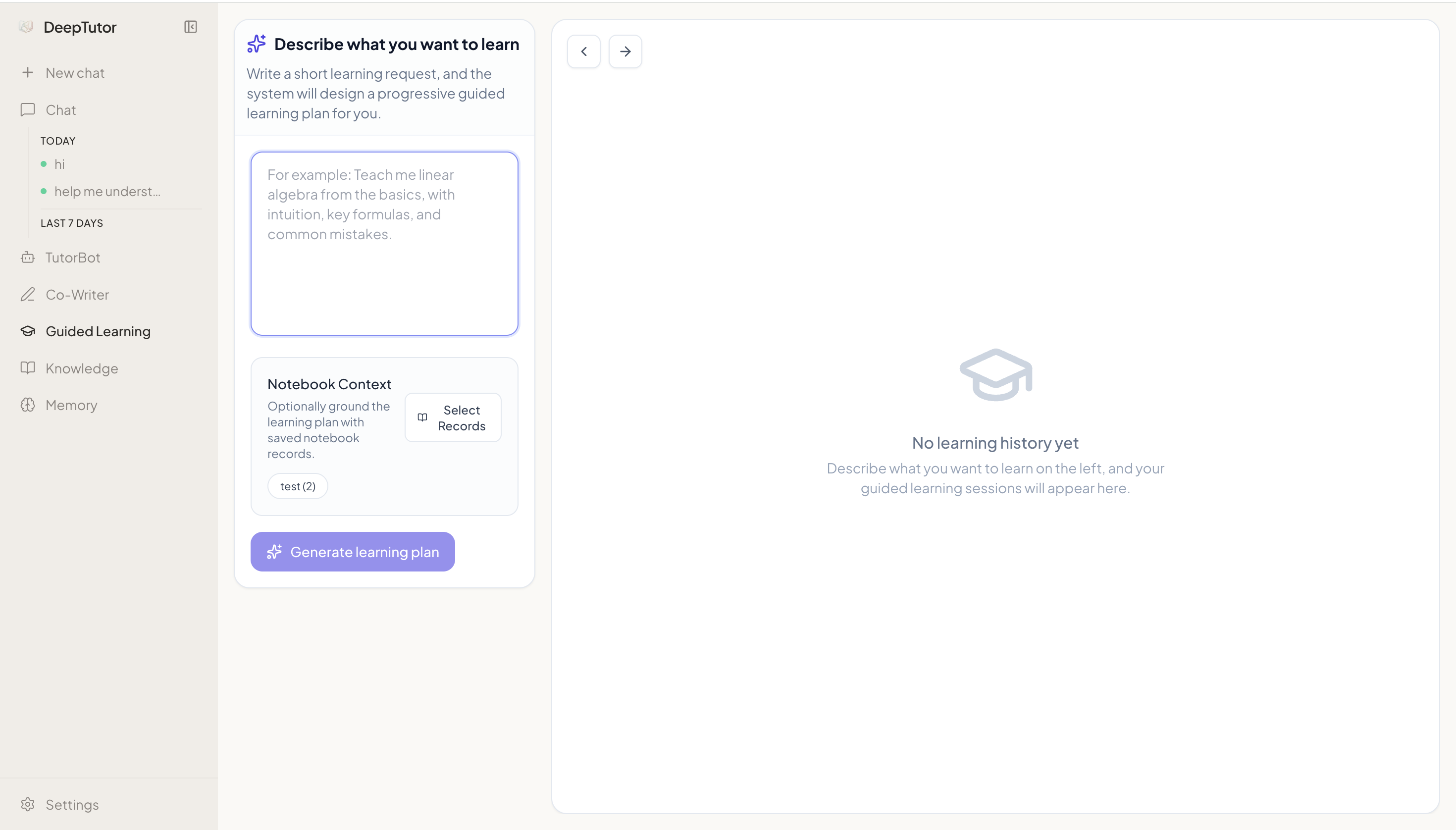
Guided Learning turns your personal materials into structured, multi-step learning journeys. Provide a topic, optionally link notebook records, and DeepTutor will:
- Design a learning plan — Identify 3–5 progressive knowledge points from your materials.
- Generate interactive pages — Each point becomes a rich visual HTML page with explanations, diagrams, and examples.
- Enable contextual Q&A — Chat alongside each step for deeper exploration.
- Summarize your progress — Upon completion, receive a learning summary of everything you've covered.
Sessions are persistent — pause, resume, or revisit any step at any time.
📚 Knowledge Management — Your Learning Infrastructure
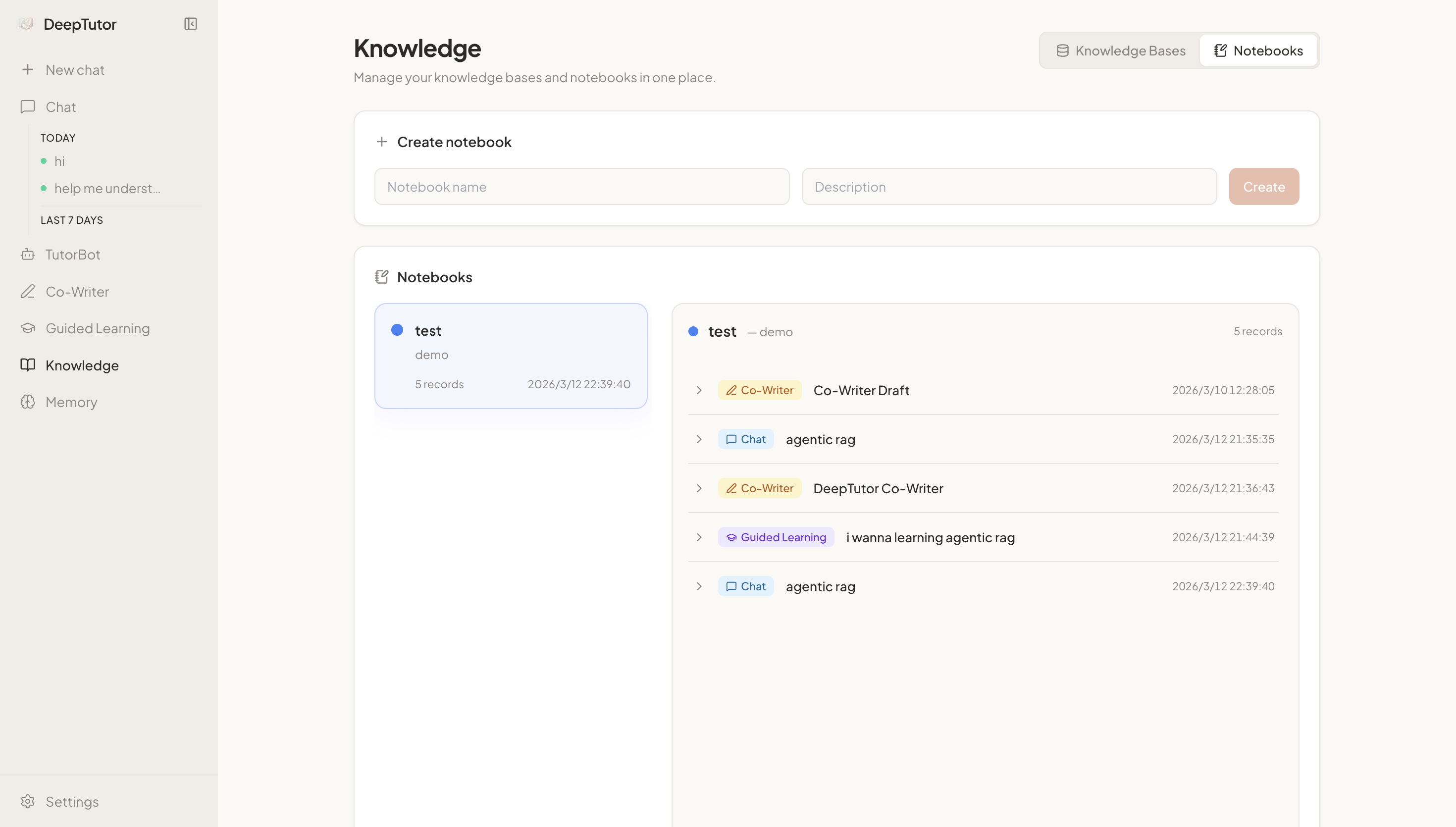
Knowledge is where you build and manage the document collections that power everything else in DeepTutor.
- Knowledge Bases — Upload PDF, TXT, or Markdown files to create searchable, RAG-ready collections. Add documents incrementally as your library grows.
- Notebooks — Organize learning records across sessions. Save insights from Chat, Guided Learning, Co-Writer, or Deep Research into categorized, color-coded notebooks.
Your knowledge base is not passive storage — it actively participates in every conversation, every research session, and every learning path you create.
🧠 Memory — DeepTutor Learns As You Learn
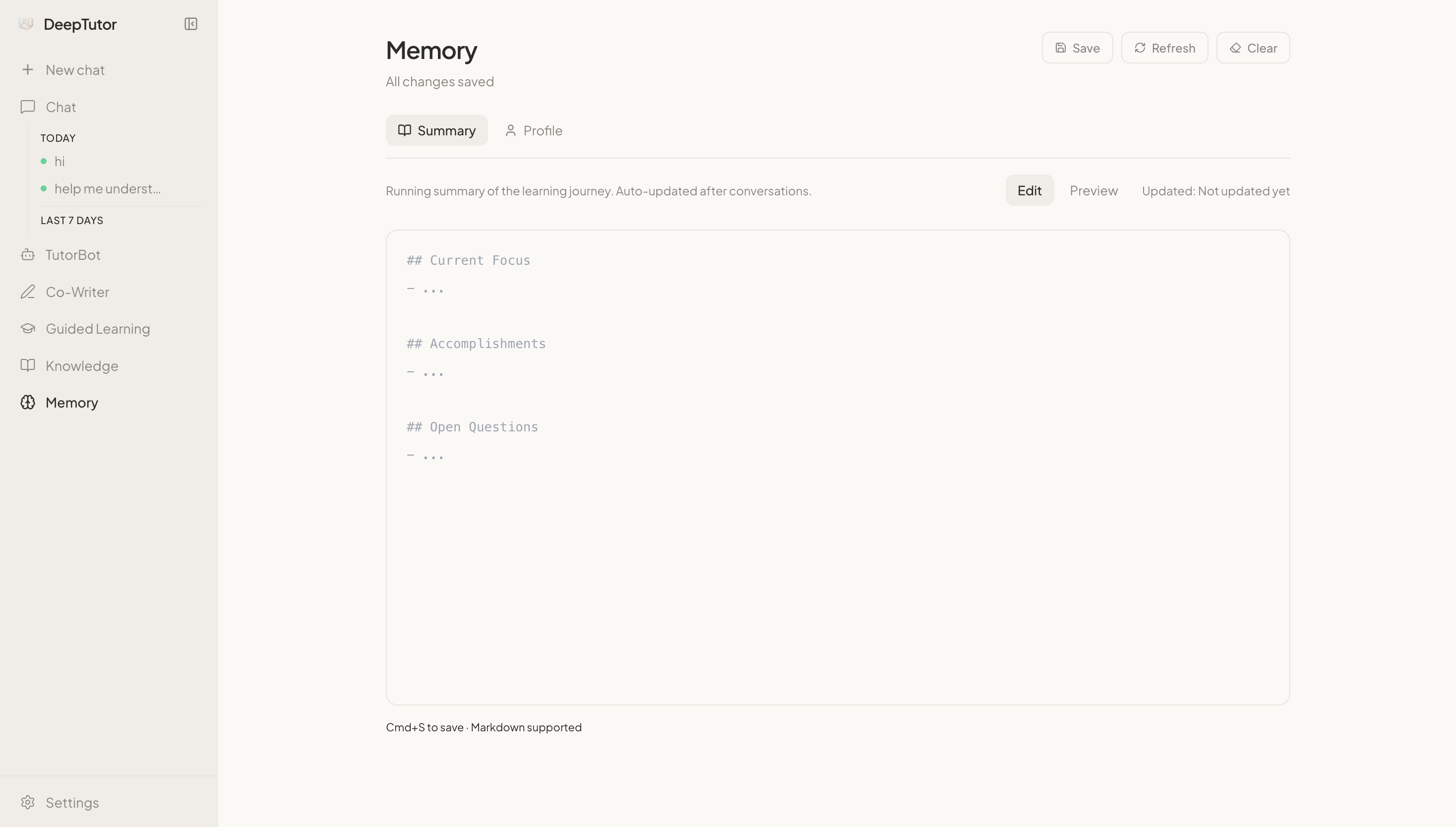
DeepTutor maintains a persistent, evolving understanding of you through two complementary dimensions:
- Summary — A running digest of your learning progress: what you've studied, which topics you've explored, and how your understanding has developed.
- Profile — Your learner identity: preferences, knowledge level, goals, and communication style — automatically refined through every interaction.
Memory is shared across all features and all your TutorBots. The more you use DeepTutor, the more personalized and effective it becomes.
🦞 TutorBot — Persistent, Autonomous AI Tutors
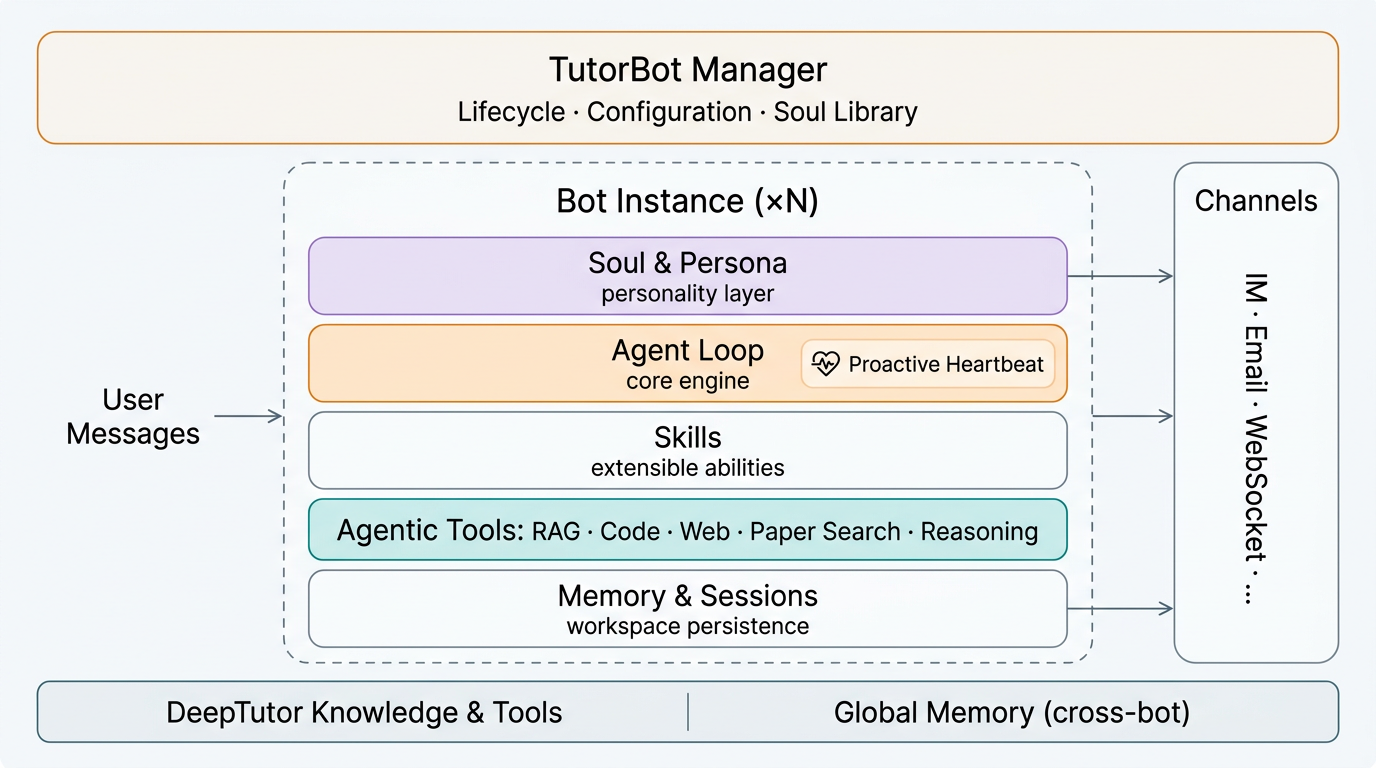
TutorBot is not a chatbot — it is a persistent, multi-instance agent built on nanobot. Each TutorBot runs its own agent loop with independent workspace, memory, and personality. Create a Socratic math tutor, a patient writing coach, and a rigorous research advisor — all running simultaneously, each evolving with you.
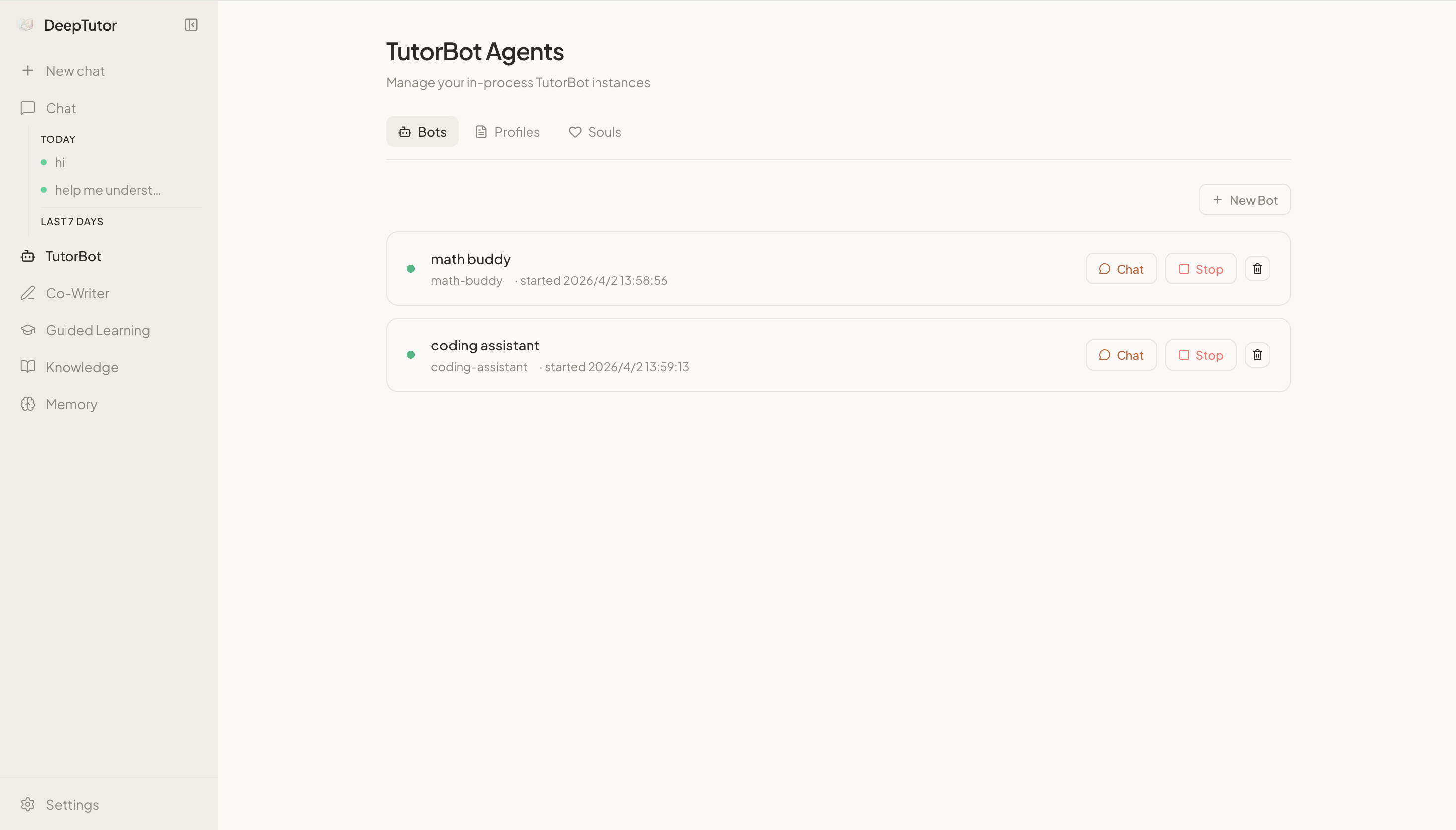
- Soul Templates — Define your tutor's personality, tone, and teaching philosophy through editable Soul files. Choose from built-in archetypes (Socratic, encouraging, rigorous) or craft your own — the soul shapes every response.
- Independent Workspace — Each bot has its own directory with separate memory, sessions, skills, and configuration — fully isolated yet able to access DeepTutor's shared knowledge layer.
- Proactive Heartbeat — Bots don't just respond — they initiate. The built-in Heartbeat system enables recurring study check-ins, review reminders, and scheduled tasks. Your tutor shows up even when you don't.
- Full Tool Access — Every bot reaches into DeepTutor's complete toolkit: RAG retrieval, code execution, web search, academic paper search, deep reasoning, and brainstorming.
- Skill Learning — Teach your bot new abilities by adding skill files to its workspace. As your needs evolve, so does your tutor's capability.
- Multi-Channel Presence — Connect bots to Telegram, Discord, Slack, Feishu, WeChat Work, DingTalk, Email, and more. Your tutor meets you wherever you are.
- Team & Sub-Agents — Spawn background sub-agents or orchestrate multi-agent teams within a single bot for complex, long-running tasks.
deeptutor bot create math-tutor --persona "Socratic math teacher who uses probing questions"
deeptutor bot create writing-coach --persona "Patient, detail-oriented writing mentor"
deeptutor bot list                  # See all your active tutors
⌨️ DeepTutor CLI — Agent-Native Interface
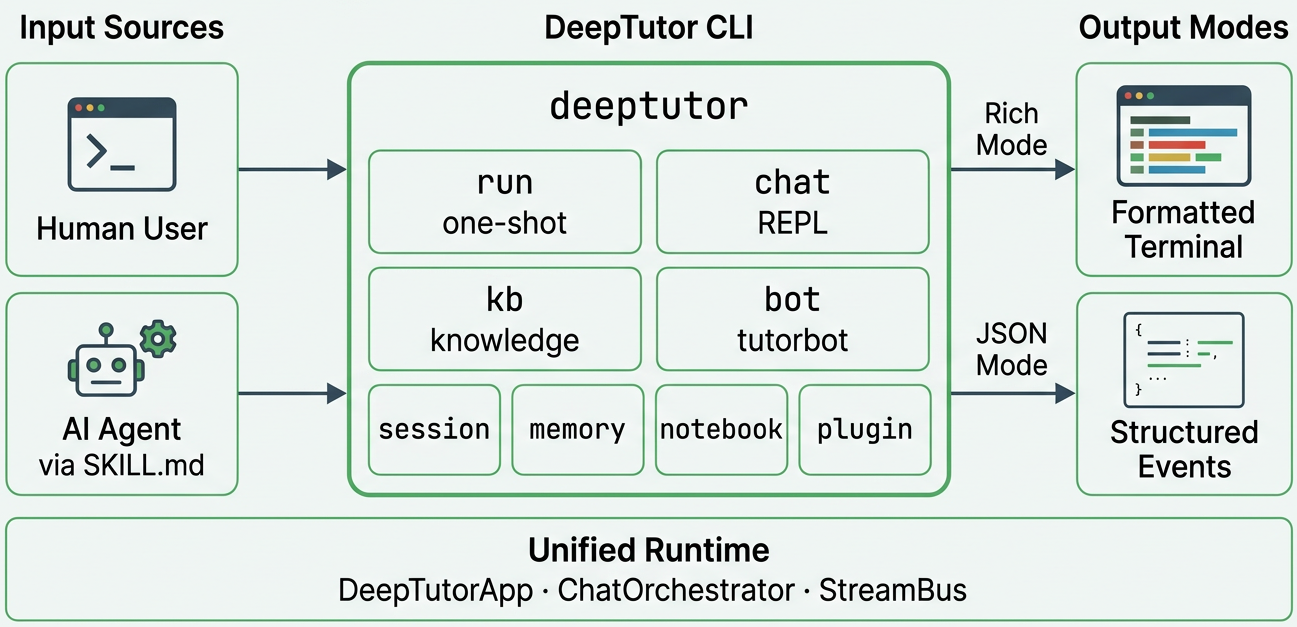
DeepTutor is fully CLI-native. Every capability, knowledge base, session, memory, and TutorBot is one command away — no browser required. The CLI serves both humans (with rich terminal rendering) and AI agents (with structured JSON output).
Hand the SKILL.md at the project root to any tool-using agent (nanobot, or any LLM with tool access), and it can configure and operate DeepTutor autonomously.
One-shot execution — Run any capability directly from the terminal:
deeptutor run chat "Explain the Fourier transform" -t rag --kb textbook
deeptutor run deep_solve "Prove that √2 is irrational" -t reason
deeptutor run deep_question "Linear algebra" --config num_questions=5
deeptutor run deep_research "Attention mechanisms in transformers"
Interactive REPL — A persistent chat session with live mode switching:
deeptutor chat --capability deep_solve --kb my-kb
# Inside the REPL: /cap, /tool, /kb, /history, /notebook, /config to switch on the fly
Knowledge base lifecycle — Build, query, and manage RAG-ready collections entirely from the terminal:
deeptutor kb create my-kb --doc textbook.pdf       # Create from document
deeptutor kb add my-kb --docs-dir ./papers/         # Add a folder of papers
deeptutor kb search my-kb "gradient descent"        # Search directly
deeptutor kb set-default my-kb                      # Set as default for all commands
Dual output mode — Rich rendering for humans, structured JSON for pipelines:
deeptutor run chat "Summarize chapter 3" -f rich    # Colored, formatted output
deeptutor run chat "Summarize chapter 3" -f json    # Line-delimited JSON events
Session continuity — Resume any conversation right where you left off:
deeptutor session list                              # List all sessions
deeptutor session open <id>                         # Resume in REPL
Full CLI command reference
Top-level
| Command | Description |
|---|---|
deeptutor run <capability> <message> |
Run any capability in a single turn (chat, deep_solve, deep_question, deep_research, math_animator) |
deeptutor chat |
Interactive REPL with optional --capability, --tool, --kb, --language |
deeptutor serve |
Start the DeepTutor API server |
deeptutor bot
| Command | Description |
|---|---|
deeptutor bot list |
List all TutorBot instances |
deeptutor bot create <id> |
Create and start a new bot (--name, --persona, `--mode |
Similar orchestration
paperclip
AI agent orchestration server for autonomous companies — manages teams of bots, goals, budgets, and governance


MiroFish
Swarm intelligence engine for future prediction — simulates multi-agent interactions to deduce outcomes


crewAI
Multi-agent orchestration framework for collaborative AI agents, independent of LangChain


langgraph
Agent orchestration framework for stateful LLM applications — builds resilient, long-running agents with durable execution


